
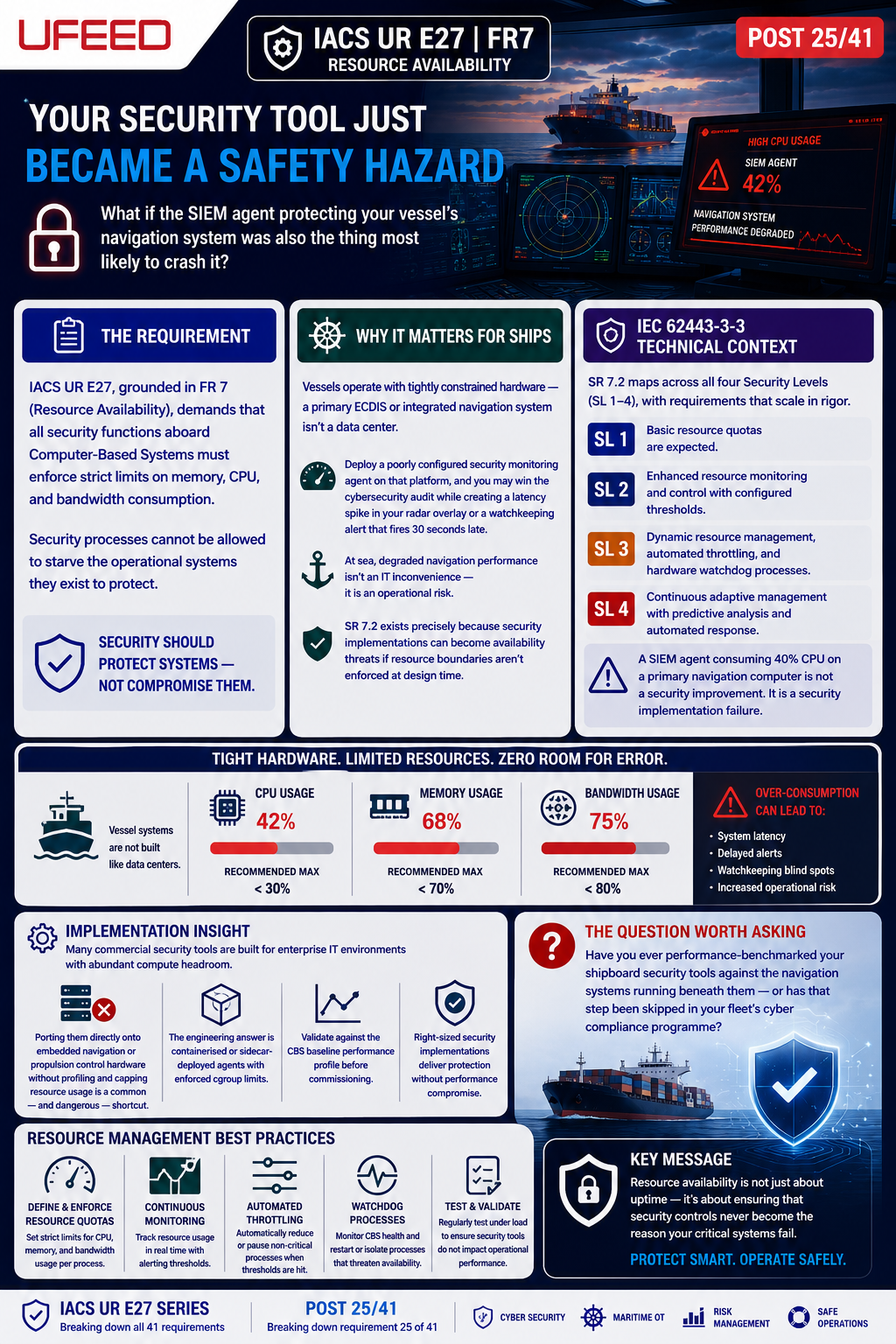
**Your security tool just became your safety hazard.**
A SIEM agent consuming 40% CPU on a primary navigation computer isn't a security win — it's a new threat vector. In maritime OT, the cure can be worse than the disease.
---
**What UR E27 Requires**
IACS UR E27 mandates that all Computer-Based Systems aboard vessels implement resource management controls that restrict how much memory, CPU, and bandwidth any security function process can consume. Security monitoring must not measurably degrade the performance of safety-critical operational systems — full stop.
---
**Why This Matters at Sea**
Navigation computers, autopilot systems, and ECDIS platforms operate in real-time environments with zero tolerance for latency introduced by poorly governed background processes. Imagine an intrusion detection agent triggering a full log flush during a constrained channel transit — every processing cycle it consumes is one the navigation system can't use. The consequence isn't a degraded dashboard; it's a degraded vessel.
Unlike enterprise IT, there is no "restart later" option when you're inbound to Rotterdam at 14 knots in reduced visibility.
---
**IEC 62443-3-3 Technical Context**
SR 7.2 under Foundational Requirement 7 (Resource Availability) addresses this precisely. It requires that IACS components enforce limits on security function resource consumption across all four Security Levels:
→ SL 1: Basic monitoring with defined resource ceilings
→ SL 2: Active enforcement with alerts on threshold breach
→ SL 3: Hardware watchdog processes monitoring CBS resource health in real time
→ SL 4: Automated failover or graceful degradation if resource limits are exceeded
The principle is intentional: security controls must never become availability risks themselves. A well-designed maritime cybersecurity architecture treats resource contention as a design failure, not an operational tradeoff.
---
**Implementation Insight**
In practice, this means OT security architects must profile baseline CPU and memory utilization for every CBS before deploying any security agent, then enforce hard resource caps at the hypervisor or OS level. On vessels running integrated bridge systems across shared hardware, this profiling step is frequently skipped — creating invisible performance debt that only surfaces under stress. Hardware watchdog timers configured to alert the ship's crew, not just a shore-based SOC, are a practical starting point. ⚓
---
**A Question for the Community**
Has your organization ever measured the real-time performance impact of security tooling on primary navigation systems before deployment — or is resource profiling still treated as a post-incident lesson?
📌 Post 25/41 in my IACS UR E27 series — breaking down all 41 requirements
#ResourceManagement #IACS #URE27 #IEC62443 #MaritimeCyberSecurity #PerformanceBalance #OTDesign


