**The encryption protecting your vessel's navigation data may already be obsolete — and you won't find out until it fails.**
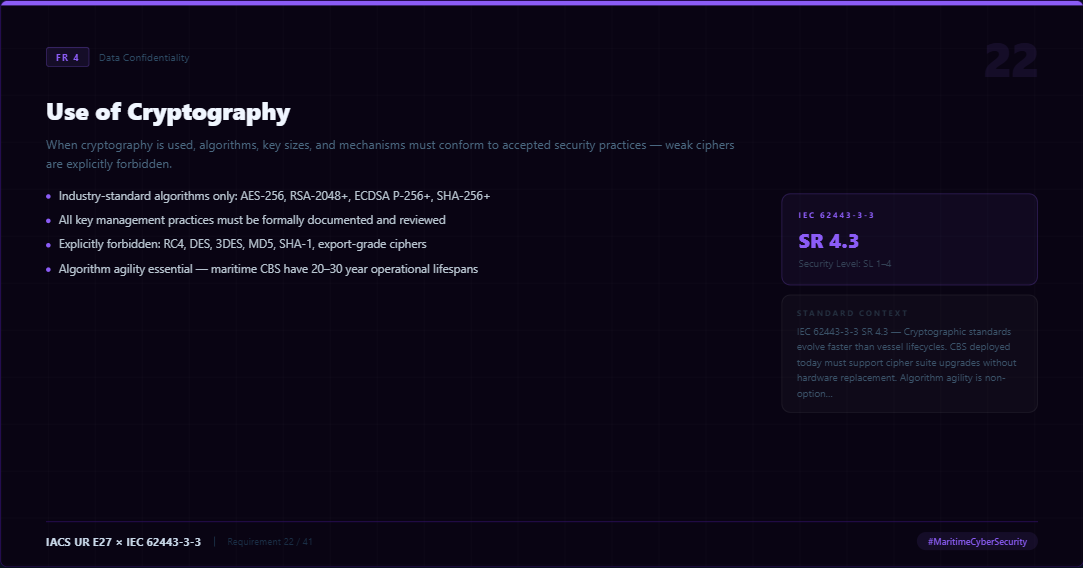
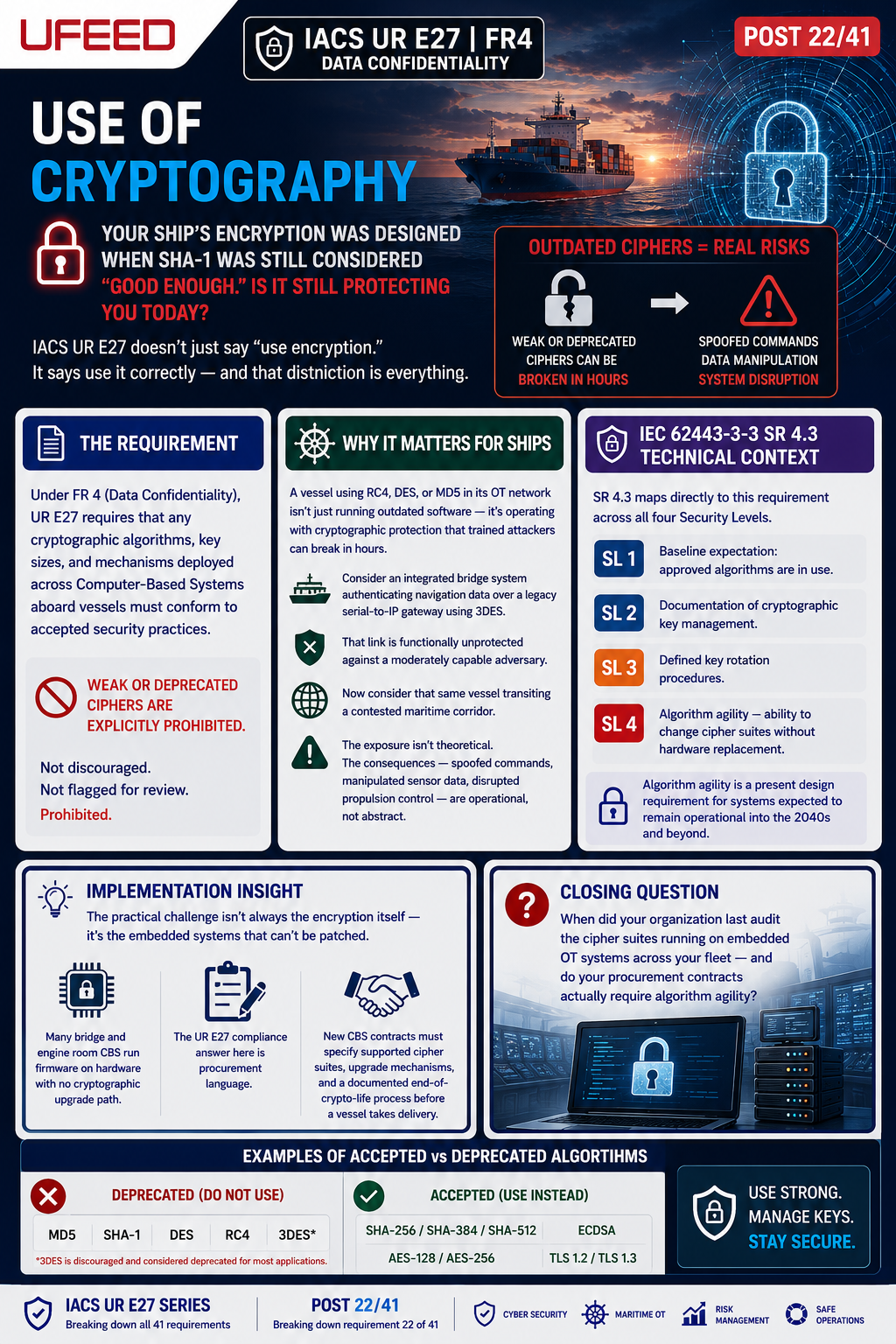
IACS UR E27 SR 4.3 is unambiguous: any cryptographic implementation aboard a Computer-Based System must conform to accepted industry standards. Weak algorithms are not a legacy concern to be tolerated — they are an explicit non-compliance. AES-256, RSA-2048 or higher, ECDSA P-256 or higher, and SHA-256 or higher set the floor. RC4, DES, 3DES, MD5, and SHA-1 are forbidden outright.
Ships are not data centres. A cryptographic library embedded in an ECDIS or integrated automation system may not receive vendor patch support for a decade. Default cipher suites shipped with OT equipment in 2018 frequently included 3DES and SHA-1 — protocols cryptanalysts had already compromised. When that system is still operational in 2034, those defaults become active vulnerabilities sitting on a network connected to propulsion, ballast, and cargo management. The gap between algorithm deprecation and fleet-wide remediation is measured in years, not months.
IEC 62443-3-3 SR 4.3 addresses this directly under Foundational Requirement 4 — Data Confidentiality — across all four Security Levels. At SL 1, the requirement establishes baseline conformance to recognised standards. At SL 2 and above, it extends to formal key management documentation and periodic review cycles. SL 3 and SL 4 demand demonstrable algorithm agility: the system architecture must support cipher suite upgrades without hardware replacement. This is not bureaucratic overhead — maritime CBS carry operational lifespans of 20 to 30 years, meaning systems commissioned today must remain cryptographically defensible into the 2050s.
One practical challenge few procurement teams anticipate: certificate pinning in legacy shipboard HMI systems. Several bridge and engine room interfaces hard-code certificate hashes or cipher preferences at the firmware level, making a cipher suite migration effectively impossible without full system replacement. Requiring vendors to document algorithm agility capabilities — and testing them during FAT — is a straightforward contractual measure that eliminates this problem before the ship leaves the yard. 🔐
Key management documentation is equally non-negotiable. Who holds the keys, how rotation is triggered, and what happens at crew changeover must be written down and reviewed — not assumed.
What does your organisation's current process look like for auditing cipher suite configurations across shipboard OT systems?
📌 Post 22/41 in my IACS UR E27 series — breaking down all 41 requirements
#Cryptography #IACS #URE27 #IEC62443 #MaritimeCyberSecurity #PKI #AlgorithmAgility


