**Your vessel's security controls were disabled for maintenance. Did anyone remember to turn them back on?**
In maritime OT environments, that question is not rhetorical — it is an incident report waiting to be written.
---
**What UR E27 Requires**
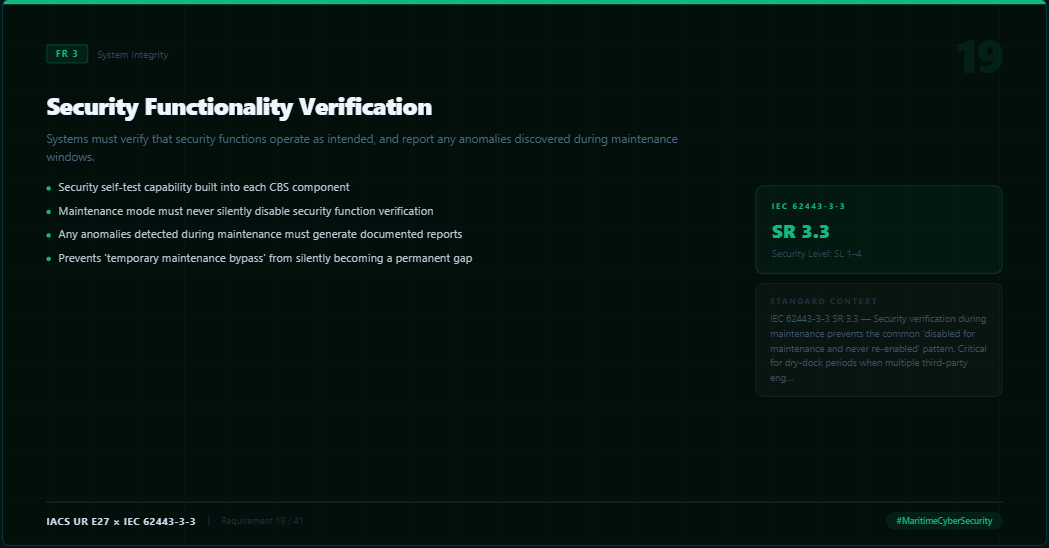
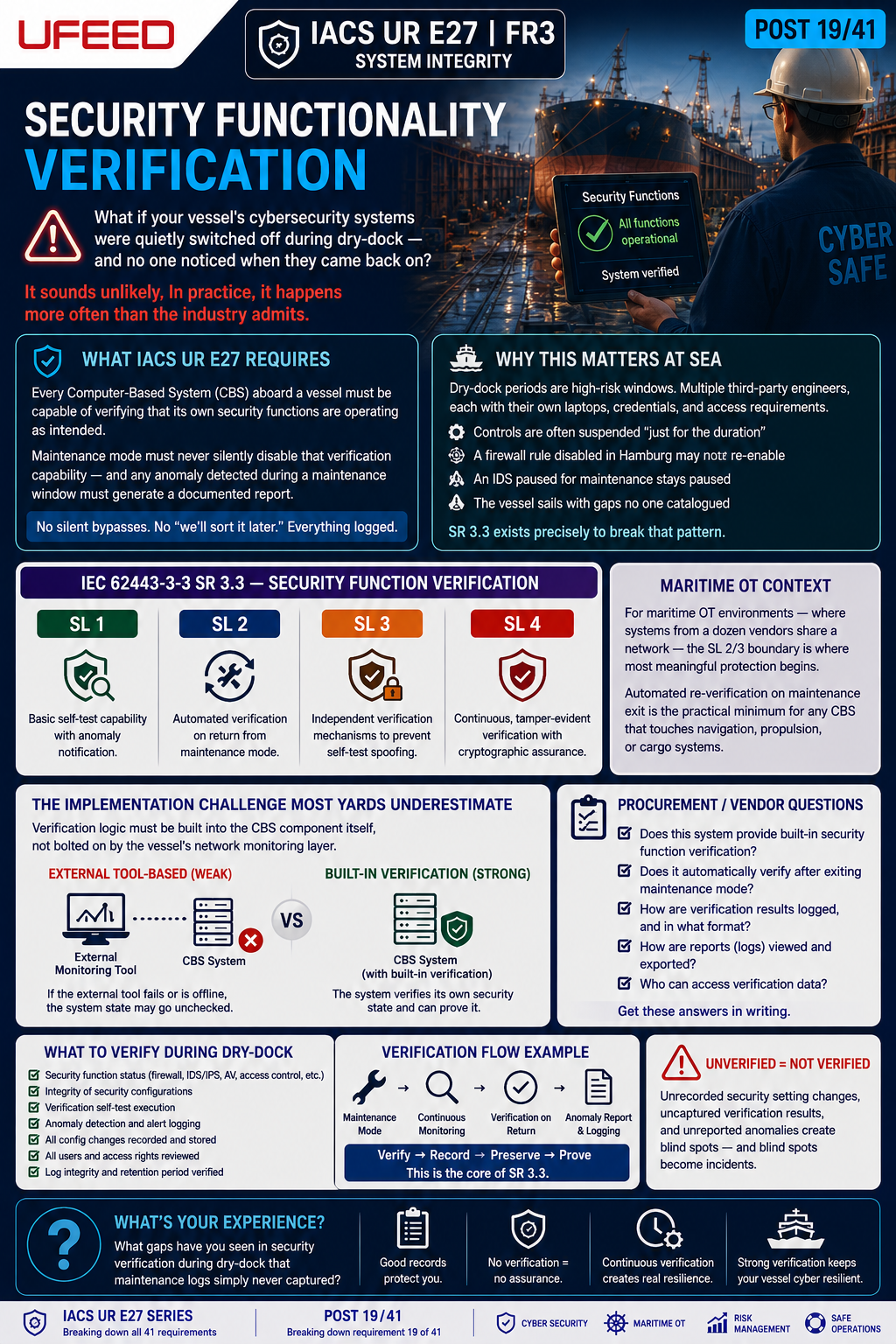
IACS UR E27 mandates that every Computer-Based System aboard a vessel must be capable of verifying its own security functions are operating as intended. Critically, maintenance mode must never silently suppress that verification. Any anomaly discovered during a self-test must generate a documented report — not a quiet log entry that no one reads, but a traceable record demanding follow-up.
---
**Why This Matters at Sea**
Dry-dock periods are the highest-risk window for this exact failure pattern. Consider the scenario: multiple third-party engineers access propulsion controls, navigation systems, and power management CBS simultaneously over several weeks, often with minimal coordinated oversight. Security functions get disabled to simplify access, commissioning work runs long, and the vessel departs with controls still in a degraded state.
Nobody intended to leave a gap. Nobody knew one existed. That is precisely the problem UR E27 addresses.
---
**The IEC 62443-3-3 Technical Foundation**
SR 3.3 under IEC 62443-3-3 directly targets security verification and aligns with FR 3 (System Integrity) across all four Security Levels:
→ SL 1: Basic self-test capability with manual review
→ SL 2: Automated verification with logged reporting
→ SL 3: Verification integrated with centralized monitoring
→ SL 4: Continuous, tamper-evident verification with independent audit trails
The standard explicitly addresses the "disabled for maintenance, never re-enabled" pattern — one of the most documented yet preventable failure modes in industrial control environments. For maritime, where OT systems may go months between formal audits, SL 2 compliance as a minimum baseline is a reasonable expectation from class society surveyors.
---
**Implementation Reality 🔧**
One practical approach is configuring CBS components to run an automated security self-test upon maintenance mode exit, with results pushed to the vessel's integrated alarm management system before normal operations resume. The technical challenge is that many legacy CBS vendors did not design self-test APIs into their systems — meaning retrofitting this capability requires careful coordination between the shipowner, integrator, and class society well before the next scheduled dry-dock.
---
Do you have visibility into which of your vessel's CBS components can actually confirm their own security functions are active and intact — right now?
---
📌 Post 19/41 in my IACS UR E27 series — breaking down all 41 requirements
#SecurityVerification #IACS #URE27 #IEC62443 #MaritimeCyberSecurity #MaintenanceSecurity
'Security > Maritime Cyber Security' 카테고리의 다른 글
| [IACS UR E27] FR4 Data Confidentiality - Information Confidentiality (0) | 2026.05.18 |
|---|---|
| [IACS UR E27] FR3 System Integrity - Deterministic Output (0) | 2026.05.15 |
| [IACS UR E27] FR3 System Integrity - Malicious Code Protection (0) | 2026.05.15 |
| [IACS UR E27] FR3 System Integrity - Communication Integrity (0) | 2026.05.15 |
| [IACS UR E27] FR2 Use Control - Timestamps (0) | 2026.05.14 |


