
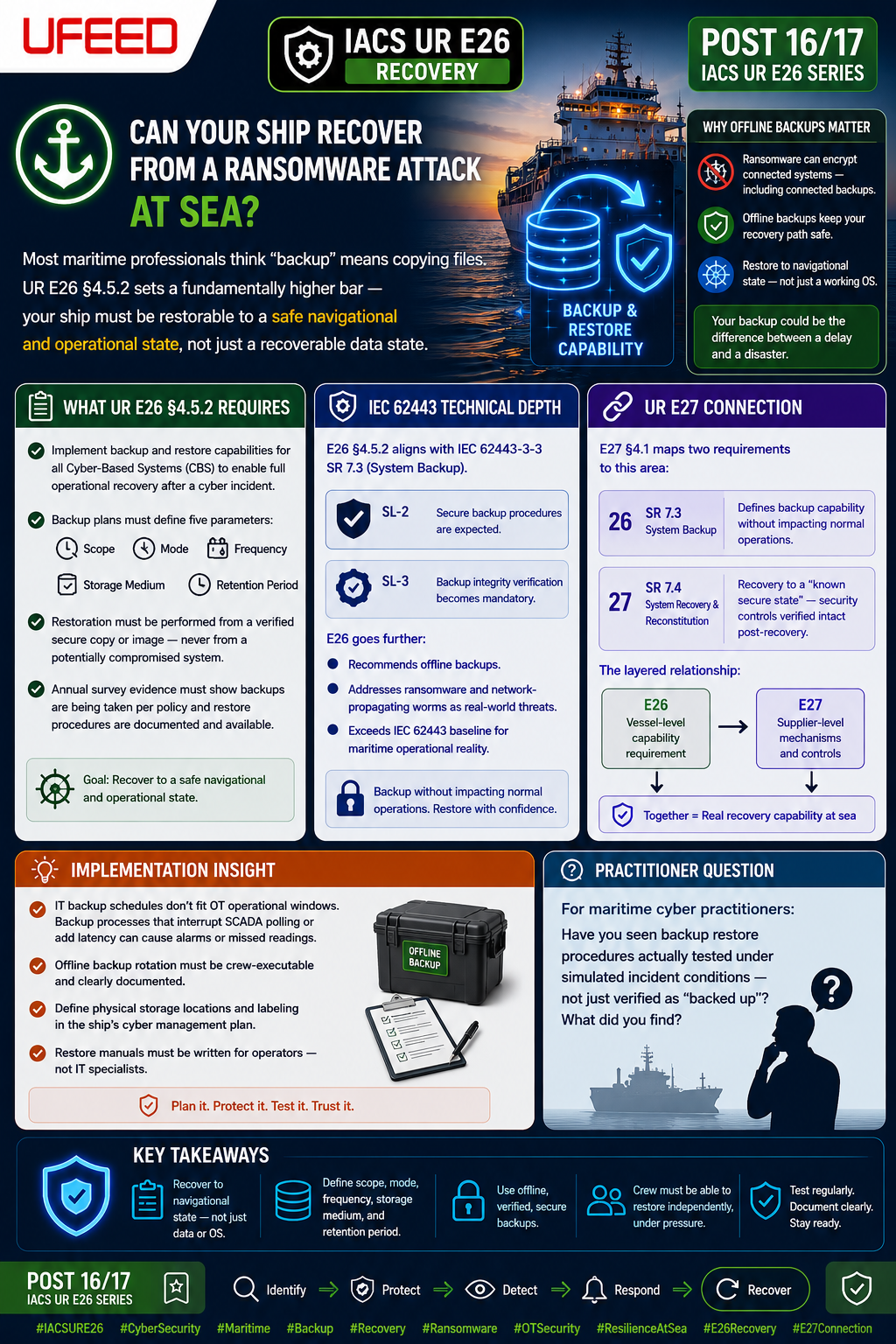
# Can Your Ship Recover from a Ransomware Attack at Sea? ⚓
Most maritime professionals think "backup" means copying files. UR E26 §4.5.2 sets a fundamentally higher bar — your ship must be restorable to a **safe navigational and operational state**, not just a recoverable data state.
**What UR E26 §4.5.2 Actually Requires**
Shipowners and system integrators must implement backup and restore capabilities for all Cyber-Based Systems (CBS) that enable full operational recovery after a cyber incident. Backup plans must explicitly define five parameters: scope, mode, frequency, storage medium, and retention period. Critically, restoration must be performed from a **verified secure copy or image** — never from a potentially compromised system. Annual survey evidence must demonstrate backups are being taken per policy and that restore procedures are documented and available.
**Why This Matters Uniquely for Ships**
A vessel mid-voyage cannot call IT support. If ECDIS, propulsion control, or cargo management systems are encrypted by ransomware, the crew must execute recovery independently — often under operational pressure, in degraded conditions, with limited connectivity. This is precisely why E26 explicitly names ransomware as a relevant threat and recommends **offline backups**: a connected backup system can be encrypted alongside the primary system, rendering recovery impossible. The requirement to restore to **navigational state** — not merely to a working OS — reflects a maritime safety imperative that goes beyond standard IT recovery objectives.
**IEC 62443 Technical Depth**
E26 §4.5.2 aligns with IEC 62443-3-3 **SR 7.3 (System Backup)**, which requires backup capability without impacting normal operations. At SL-2, secure backup procedures are expected; at SL-3, backup integrity verification becomes mandatory. E26's offline backup recommendation directly exceeds the IEC 62443 baseline — acknowledging that ransomware and network-propagating worms represent documented, real-world threats to shipping companies, port operators, and maritime logistics providers.
**UR E27 Connection**
E27 §4.1 maps two requirements to this area: item 26 (SR 7.3, System Backup) and item 27 (SR 7.4, System Recovery and Reconstitution). SR 7.4 introduces a stronger target than E26 alone: recovery to a **"known secure state"** — meaning security controls must be verified intact post-recovery, not just services running. The layered relationship matters: E26 defines the vessel-level capability requirement; E27 drives suppliers to build the component-level mechanisms that make vessel-level recovery actually achievable.
**Implementation Insight** 🛡️
One persistent challenge: backup schedules designed for IT environments don't account for OT operational windows. Backup processes that interrupt SCADA polling cycles or introduce latency on control networks can cause nuisance alarms — or worse, missed sensor readings. Offline backup rotation procedures also need to be crew-executable, with clear labeling, physical storage locations defined in the ship's cyber management plan, and restore manuals written for operator-level competency, not IT specialist knowledge.
**For maritime cyber practitioners: have you seen backup restore procedures actually tested under simulated incident conditions — not just verified as "backed up"? What did you find?**
📌 Post 16/17 in my IACS UR E26 series — breaking down all 17 requirements across the Identify → Protect → Detect → Respond → Recover framework
'Security > Maritime Cyber Security' 카테고리의 다른 글
| [IACS UR E26] Recovery – 17 Controlled Shutdown, Reset, Roll-back & Restart (0) | 2026.06.02 |
|---|---|
| [IACS UR E26] Recovery – 15 Recovery Plan (0) | 2026.06.02 |
| [IACS UR E26] Respond – 14 Fallback to Minimal Risk Condition (0) | 2026.06.01 |
| [IACS UR E26] Respond – 13 Network Isolation (0) | 2026.06.01 |
| [IACS UR E26] Respond – 12 Local, Independent & Manual Operation (0) | 2026.06.01 |


