# 🔌 Can your crew isolate a compromised OT network zone — without a laptop, without calling IT, and without losing propulsion?
That's the exact scenario UR E26 §4.4.3 is designed for.
**What UR E26 §4.4.3 Requires**
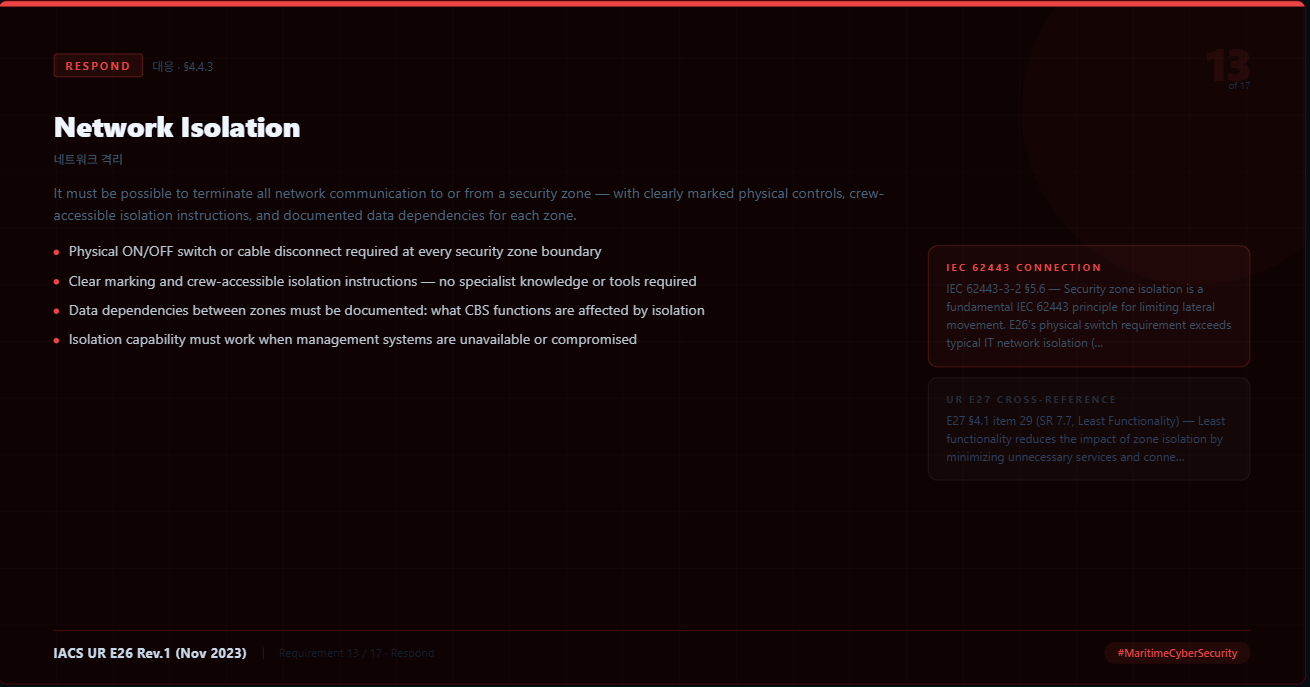
Every security zone boundary must support complete network termination — inbound and outbound. The standard mandates physically marked controls (switches or cable disconnects), crew-accessible isolation instructions requiring no specialist tools or knowledge, and documented data dependencies for every zone so decision-makers know what CBS functions go offline when they pull the plug.
**Why This Is Different at Sea**
Offshore incidents don't come with an IT helpdesk on speed dial. When a vessel is mid-passage and a zone is actively compromised, the crew — not a security engineer — must act. E26's physical switch requirement is a deliberate design choice: software-based isolation commands depend on management systems that may themselves be unavailable or compromised during the very event that triggers the isolation. The requirement forces the solution to be durable under adversarial conditions, not just normal ones.
**IEC 62443 Technical Depth**
E26 §4.4.3 builds directly on IEC 62443-3-2 §5.6, which establishes zone isolation as a foundational principle for limiting lateral movement between security zones and conduits. Standard IT implementations typically rely on SDN commands or management software for network segmentation — acceptable when infrastructure is intact. E26 exceeds this baseline by requiring physical disconnection capability, recognizing that maritime OT environments must achieve isolation even when the management plane is the compromised asset. This is a meaningful architectural constraint, not a formality.
**The UR E27 Connection**
E27 §4.1 item 29 maps to IEC 62443-3-3 SR 7.7 (Least Functionality) at the system and component level. The pairing is architecturally intentional:
→ SR 7.7 reduces attack surface proactively — fewer active services and connections to manage during an incident
→ E26 §4.4.3 provides reactive containment capability when something penetrates anyway
Least functionality shrinks what isolation must contain. Zone isolation contains what least functionality didn't prevent. These two requirements form a genuine defense-in-depth pair across the E26/E27 boundary.
**Implementation Insight**
The data dependency documentation requirement is where most projects underestimate the effort. Each zone's isolation impact — which CBS functions degrade, which fail completely, which fail safely — must be analyzed and recorded at design stage. In practice, this forces conversations between naval architects, system integrators, and OT security teams that often haven't happened yet. Start that mapping early; retrofitting it onto a completed design is significantly more costly.
**Engagement Question**
Have you encountered vessel designs where zone isolation capability was added late — and what did that rework actually cost? 👇
📌 Post 13/17 in my IACS UR E26 series — breaking down all 17 requirements across the Identify → Protect → Detect → Respond → Recover framework

'Security > Maritime Cyber Security' 카테고리의 다른 글
| [IACS UR E26] Recovery – 15 Recovery Plan (0) | 2026.06.02 |
|---|---|
| [IACS UR E26] Respond – 14 Fallback to Minimal Risk Condition (0) | 2026.06.01 |
| [IACS UR E26] Respond – 12 Local, Independent & Manual Operation (0) | 2026.06.01 |
| [IACS UR E26] Respond – 11 Incident Response Plan (0) | 2026.06.01 |
| [IACS UR E26] Detect – 10 CBS & Network Verification and Diagnostic Functions (0) | 2026.06.01 |


