**Your remote maintenance session just became the attacker's remote maintenance session — and your system doesn't even know it happened.**
This is the threat that IACS UR E27 Session Integrity requirements are designed to stop.
**What UR E27 Requires**
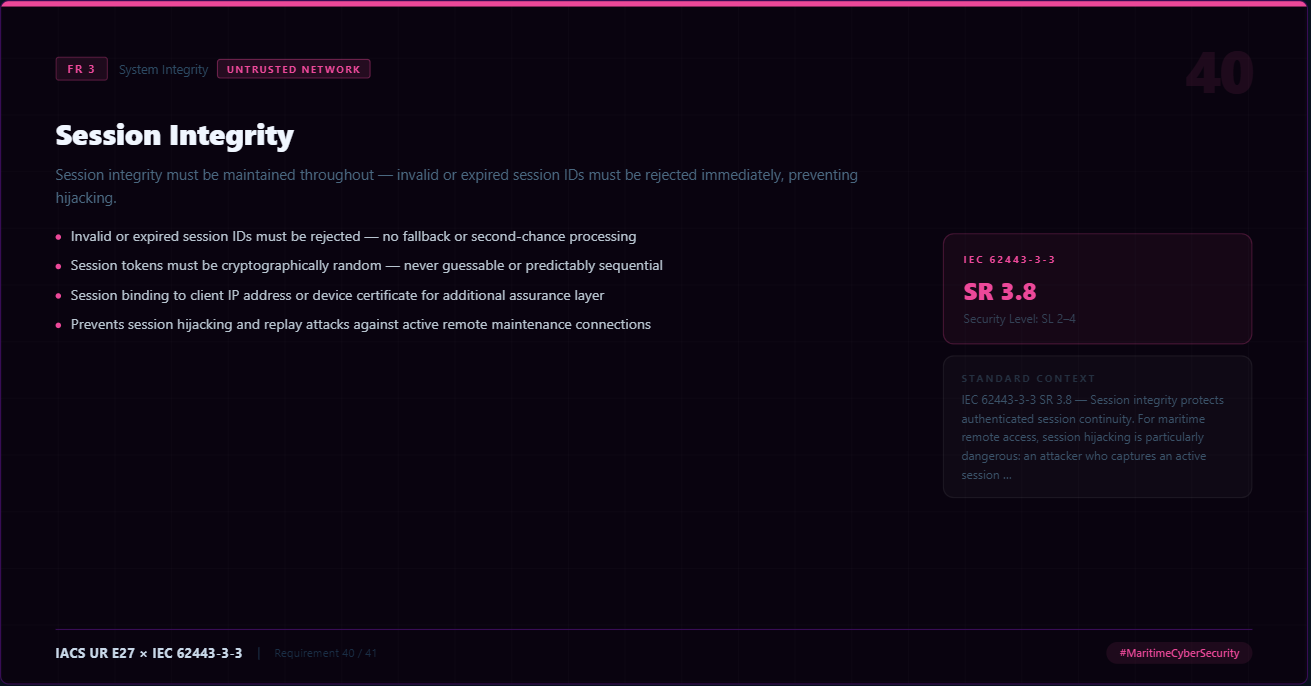
Under FR 3 (System Integrity), UR E27 mandates that every session token used to access a Cyber-Based System must be validated continuously — not just at login. Invalid or expired session IDs must be rejected immediately, with no fallback processing. There is no second chance, no graceful degradation. The session is either valid or it is terminated.
**Why This Matters at Sea**
Remote maintenance access to vessel systems — propulsion controllers, ballast automation, power management — is now standard practice. But an active session token intercepted over a poorly secured satellite link is functionally equivalent to handing an attacker the keys to the engine room.
→ A hijacked session requires no credentials — authentication already happened
→ The attacker inherits every privilege the legitimate engineer holds
→ At sea, detection can lag by hours; by then, damage is done
The vessel's geographic isolation transforms a typical session hijacking incident into a potential safety event.
**IEC 62443-3-3 SR 3.8 — The Technical Standard**
SR 3.8 addresses session integrity as a distinct control, mapped across SL 2 through SL 4, reflecting that higher-criticality systems demand progressively stronger session protection.
The control requires:
→ Cryptographically random session tokens — never sequential, never predictable
→ Immediate invalidation of expired or anomalous session IDs
→ Session binding — tying tokens to client IP address or device certificate to prevent lateral token use
At SL 3 and SL 4, this binding becomes essential. A token captured from one network context must be rendered useless in another.
**Implementation Reality in Maritime OT**
The practical challenge is that many legacy OT platforms were not designed with session token management in mind. Vendors building remote access gateways for CBS must retrofit cryptographic randomness and session binding onto protocols that predate these concepts — often while preserving backward compatibility with installed shipboard equipment. This is where the gap between policy intent and system capability becomes most visible.
🔒 When did your organisation last audit the session management implementation — not the policy, the actual code — in your shipboard remote access infrastructure?

📌 Post 40/41 in my IACS UR E27 series — breaking down all 41 requirements
'Security > Maritime Cyber Security' 카테고리의 다른 글
| [IACS UR E26] Identify – 01 Vessel Asset Inventory (0) | 2026.05.27 |
|---|---|
| [IACS UR E27] Untrusted Network – 41 Session ID Invalidation after Termination (0) | 2026.05.26 |
| [IACS UR E27] Untrusted Network – 39 Input Validation (0) | 2026.05.26 |
| [IACS UR E27] Untrusted Network – 38 Cryptographic Integrity Protection (0) | 2026.05.26 |
| [IACS UR E27] Untrusted Network – 37 Remote Session Termination (0) | 2026.05.26 |


