
**What if a ship's navigation system accepted false position data as truth — and no one checked?**
AIS spoofing isn't theoretical. Ghost vessels, phantom collisions, and forged waypoints have all been documented in the wild. The question isn't whether malformed data will arrive at your systems — it's whether your systems will blindly trust it.
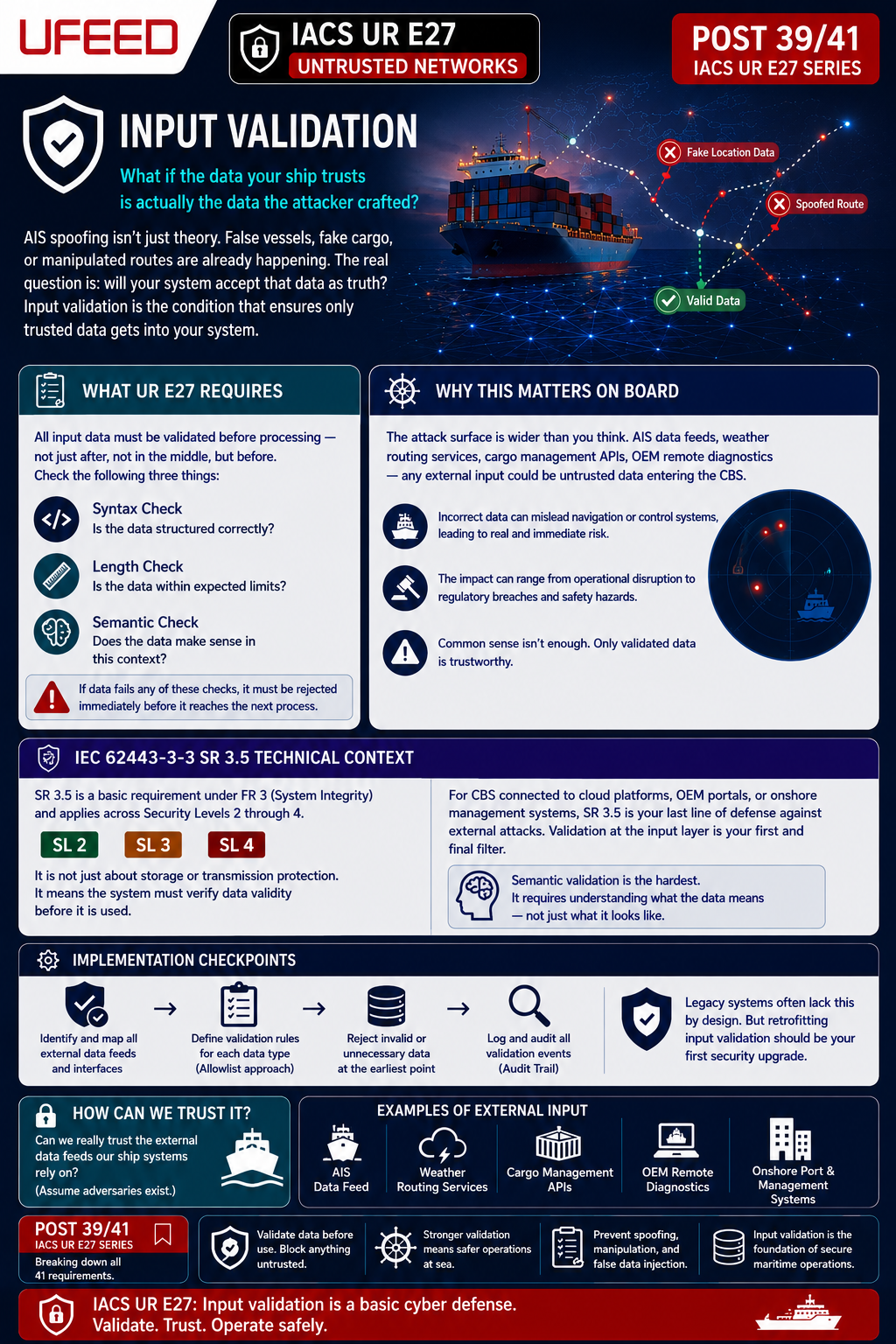
**UR E27 requires that all input data used for process control or CBS operations be validated before processing — not after, not during, but before.**
That means checking three things: the syntax of the data (is it structurally correct?), the length (does it fall within expected bounds?), and the semantic content (does it actually make sense in context?). Anything that fails those checks must be rejected or fully sanitized before it ever reaches processing logic.
**For ships, this requirement has immediate operational teeth.**
The attack surface is broader than most teams realise. AIS data feeds, weather routing services, cargo management APIs, OEM remote diagnostic streams — all of these represent untrusted external inputs that flow into CBS. A single malformed or maliciously crafted packet that bypasses validation and reaches navigation or propulsion logic isn't a theoretical concern. It's a pathway to control system compromise or, at minimum, hazardous operational decisions made on corrupted data.
The consequences range from navigational error to regulatory non-compliance to vessel detention. The common thread: someone trusted input they shouldn't have.
**IEC 62443-3-3 SR 3.5 sits within Foundational Requirement 3 — System Integrity — and is mandatory from SL 2 through SL 4.**
This reflects a deliberate design philosophy: integrity isn't just about protecting data at rest or in transit. It's about ensuring that what a system acts upon is valid before the action is taken. For maritime OT, where CBS increasingly receive data from cloud-connected OEM portals and shoreside management systems, SR 3.5 becomes the last line of defence against injection attacks arriving through legitimate-looking data channels.
The technical challenge worth flagging: semantic validation is harder than syntax checking. A position coordinate can be structurally perfect and still be geographically impossible.
**A practical starting point: build an input validation layer at the boundary of every external data feed, enforce strict allowlisting of expected data formats, and log every rejection with sufficient context for forensic review.**
This isn't complex engineering — but it requires deliberate architecture decisions that many legacy CBS integrations simply weren't built with.
🔒 How confident are you that your vessel's external data feeds are validated at the point of ingestion — not just at the application layer?
📌 Post 39/41 in my IACS UR E27 series — breaking down all 41 requirements


