
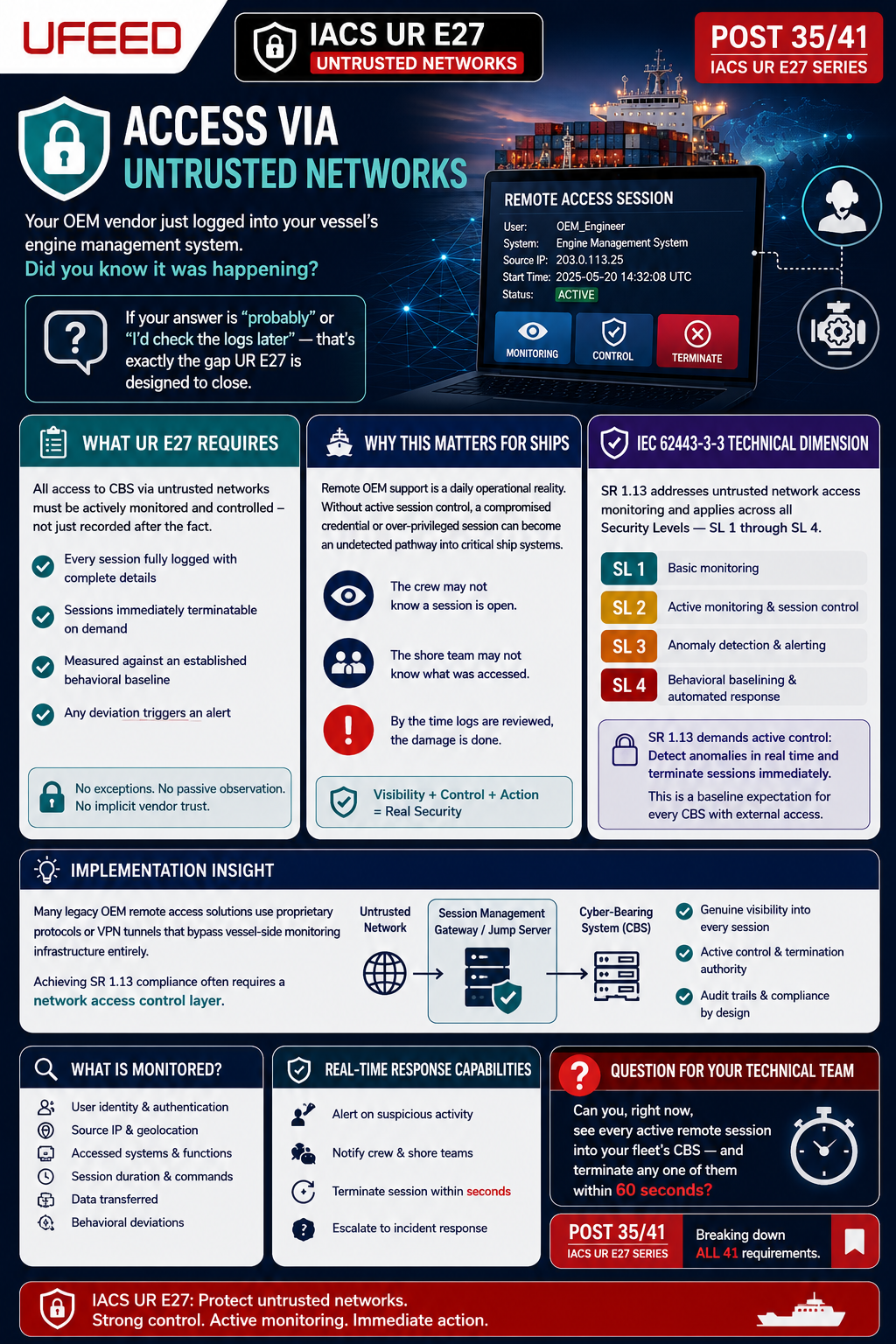
**Your OEM vendor just logged into your vessel's engine management system. Did you know it was happening?**
If your answer is "probably" or "I'd check the logs later" — that's exactly the gap UR E27 is designed to close.
**What UR E27 Requires Here**
IACS UR E27 mandates that all access to Cyber-Bearing Systems (CBS) via untrusted networks must be actively monitored and controlled — not just recorded after the fact. Every session must be fully logged with complete details, immediately terminatable on demand, and measured against an established behavioral baseline. Any deviation triggers an alert. No exceptions, no passive observation, no implicit vendor trust.
**Why This Matters for Ships**
Remote OEM support is a daily operational reality in modern shipping. Engine manufacturers, navigation system vendors, and automation suppliers routinely connect to vessels at sea — often with broad system access and minimal crew oversight. Without active session control, a compromised vendor credential or an over-privileged support session becomes an undetected pathway directly into critical shipboard systems. The crew may not know a session is open. The shore team may not know what was accessed. By the time the logs are reviewed, the damage is done.
**The IEC 62443-3-3 Technical Dimension**
SR 1.13 addresses untrusted network access monitoring and applies across all Security Levels — SL 1 through SL 4 — meaning this is not a high-tier optional requirement. It is a baseline expectation for every CBS with an external network interface. The key technical distinction is between passive logging and active control: SR 1.13 demands the capability to detect anomalies in real time and to terminate sessions immediately. At higher security levels, this extends to behavioral baselining — the system must understand what normal vendor access looks like and flag anything outside that envelope automatically.
**Implementation Insight**
One practical challenge: many legacy OEM remote access solutions use proprietary protocols or VPN tunnels that bypass vessel-side monitoring infrastructure entirely. Achieving SR 1.13 compliance often requires deploying a network access control layer — a dedicated jump server or session management gateway — that sits between the untrusted network and the CBS, giving the crew or shore security team genuine visibility and termination authority over every active connection. 🔐
**A question worth asking your technical team:** Can you, right now, see every active remote session into your fleet's CBS — and terminate any one of them within 60 seconds?
📌 Post 35/41 in my IACS UR E27 series — breaking down all 41 requirements


