
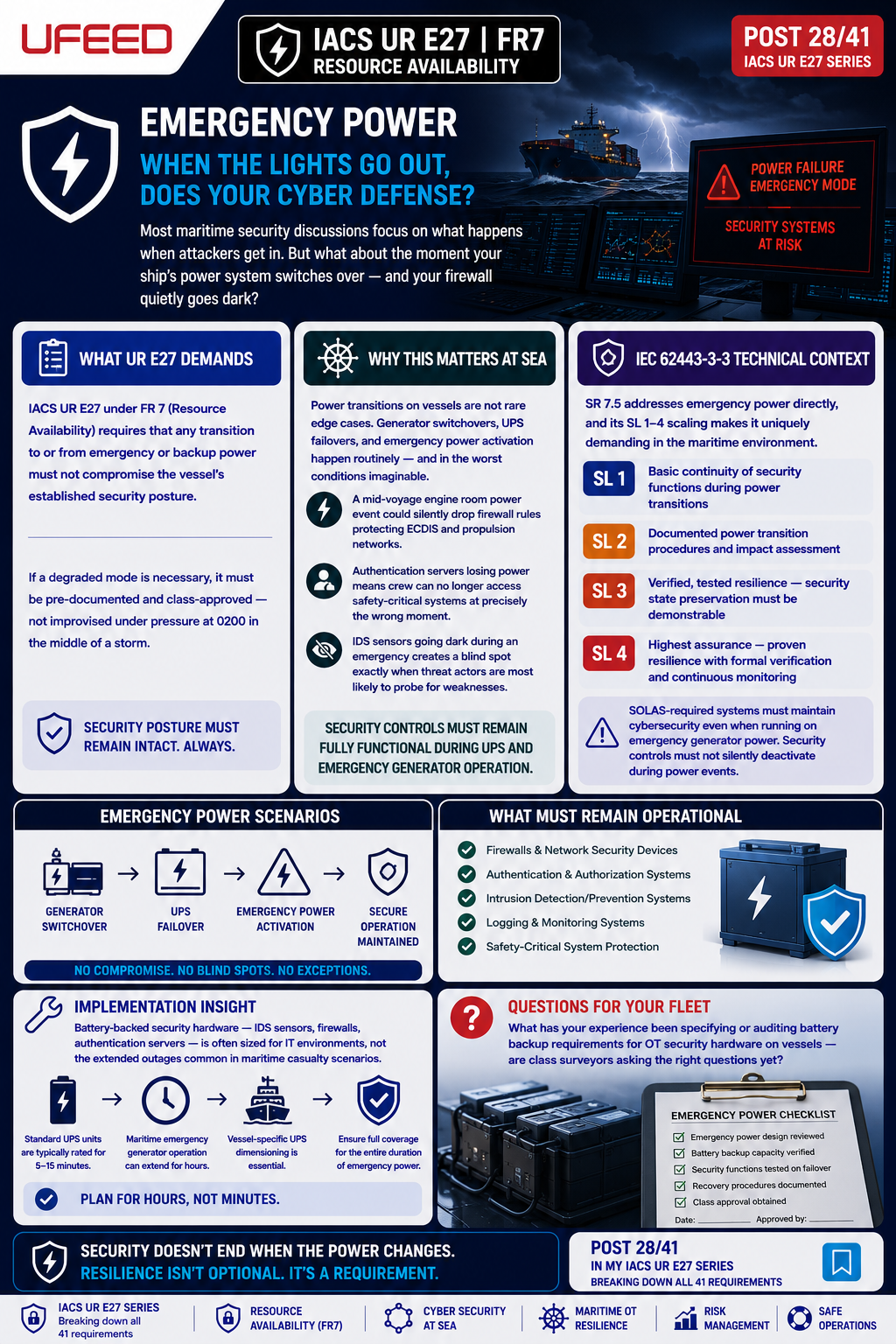
# When the Lights Go Out, Do Your Cyber Defenses Go With Them?
A power blackout at sea is already a high-stakes event. If your security controls silently switch off at the same moment, you've handed an attacker a perfect window.
---
**What IACS UR E27 Actually Requires**
UR E27 demands that switching to or from emergency or backup power must not degrade, disrupt, or compromise the vessel's current security posture. If a degraded operating mode is necessary, it must be pre-documented, pre-approved by class, and activated intentionally — never by accident.
---
**Why This Is a Distinctly Maritime Problem**
Power transitions at sea happen without warning, under stress, and during exactly the kinds of emergencies that also elevate cyber attack risk. Consider the scenario: a main switchboard fault triggers an emergency generator transfer at 0200. In that transition window, authentication servers drop, firewall rulesets reset to default, and IDS sensors go dark — all within seconds. Meanwhile, your ECDIS, propulsion control, and cargo management systems are still running. That combination — live critical systems, absent security controls — is precisely what sophisticated threat actors anticipate.
---
**The IEC 62443-3-3 Technical Foundation**
SR 7.5 under IEC 62443-3-3 addresses emergency power specifically within the broader FR 7 Resource Availability framework. Across all four Security Levels, the requirement scales in rigor:
→ SL 1: Documented degraded mode exists and is communicated
→ SL 2: Security state is preserved automatically during power transitions
→ SL 3: No security function may deactivate without explicit authorized action
→ SL 4: Continuous availability with no degradation permitted, even transiently
For maritime applications, the key technical insight is that SL 2 and above require battery-backed continuity for security hardware — IDS sensors, authentication servers, and firewalls must have independent UPS capacity, not share the same power bus as the systems they protect.
---
**Implementation Insight**
One underestimated challenge is firewall state table preservation. Many industrial firewalls flush active session tables on power loss, effectively forcing all OT connections to re-authenticate simultaneously. On a vessel mid-maneuver, that re-authentication storm can cause brief but dangerous control system delays. Specifying stateful session persistence in UPS-backed hardware procurement is a small change with significant operational consequence. ⚡
---
**A Question Worth Raising in Your Next Vessel Audit**
Have you tested your CBS security controls specifically during a simulated emergency power transfer — not just confirmed they restart afterward, but verified they remained active throughout?
---
📌 Post 28/41 in my IACS UR E27 series — breaking down all 41 requirements
#EmergencyPower #IACS #URE27 #IEC62443 #MaritimeCyberSecurity #SOLAS #PowerResilience
'Security > Maritime Cyber Security' 카테고리의 다른 글
| IACS UR E27 - Introduction (0) | 2026.05.24 |
|---|---|
| [IACS UR E27] FR7 Resource Availability - Least Functionality (0) | 2026.05.21 |
| [IACS UR E27] FR7 Resource Availability - System Recovery & Reconstitution (0) | 2026.05.21 |
| [IACS UR E27] FR7 Resource Availability - System Backup (0) | 2026.05.21 |
| [IACS UR E27] FR7 Resource Availability - Resource Management (0) | 2026.05.21 |


