# What if your ship's GPS heading was silently changed by 15 degrees — and no system raised an alarm?
That's not a hypothetical. It's exactly the scenario communication integrity controls exist to prevent.
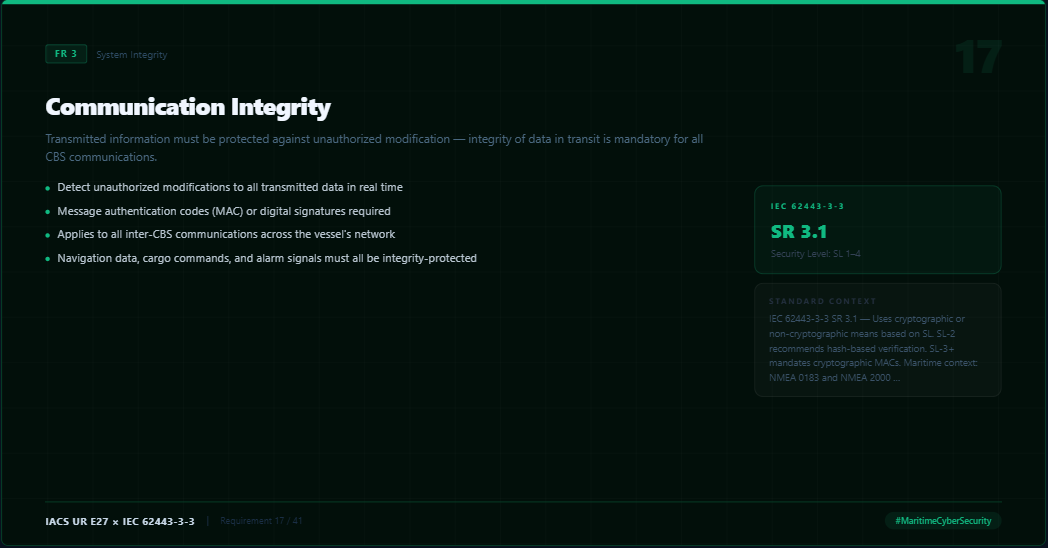
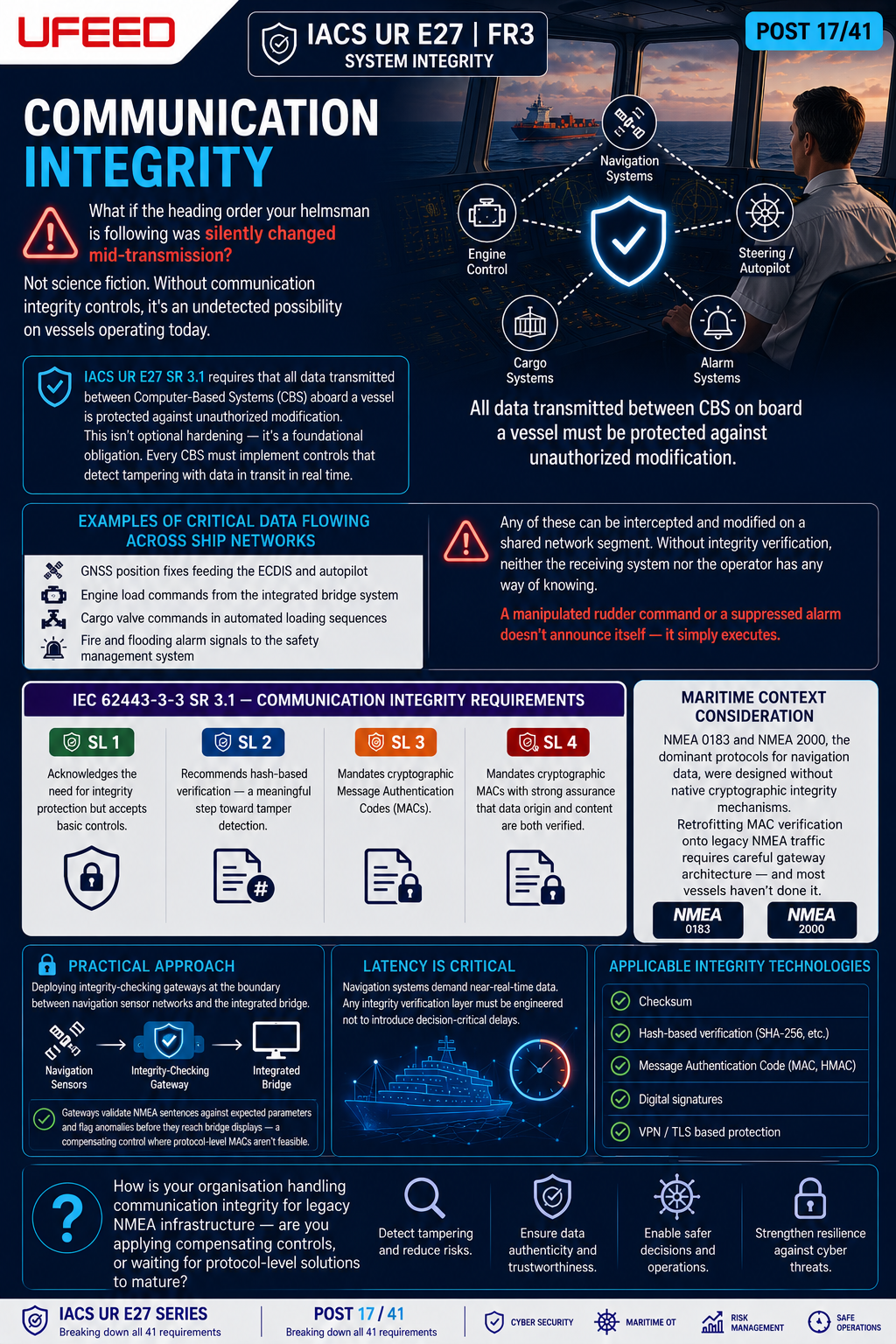
**IACS UR E27 — FR 3 (System Integrity) demands that all data transmitted between Computer-Based Systems aboard a vessel must be protected against unauthorized modification.** This isn't optional for specific systems — it applies across every CBS communication on the ship's network, from bridge to engine room to cargo control.
Why does this matter operationally? Consider the data flows that keep a vessel safe:
→ Navigation data (heading, position, speed) feeding the autopilot
→ Cargo management commands directing ballast and loading systems
→ Alarm and shutdown signals from machinery protection systems
If any of these transmissions can be silently altered in transit — whether by a cyber attacker, a misconfigured system, or even a network fault — the consequences range from incorrect vessel positioning to a cargo list, or worse, a suppressed high-temperature alarm in the engine room. The ship acts on corrupted instructions without ever knowing the data was changed.
**IEC 62443-3-3 SR 3.1 maps this requirement across four Security Levels with increasing cryptographic rigour.** At SL-1, basic integrity checking is acceptable — think simple checksums. SL-2 steps this up to hash-based verification (e.g., HMAC-SHA256), ensuring any in-transit modification is detectable. At SL-3 and SL-4, cryptographic Message Authentication Codes become mandatory, providing both integrity and authenticity assurance — meaning the receiving system can verify not just that data arrived unchanged, but that it came from a trusted source.
The maritime implementation challenge here is real: **NMEA 0183 and NMEA 2000 — the dominant protocols carrying navigation data on most commercial vessels — were designed decades ago with zero native integrity protection.** Retrofitting cryptographic controls onto legacy navigation networks requires gateway-level integrity enforcement, careful network segmentation, and in many cases, hardware replacement. Integrators need to solve this without introducing latency that affects real-time navigation system performance.
One practical approach gaining traction: deploying integrity-checking gateways at network boundaries that validate NMEA data streams before they reach integrated bridge systems, without requiring protocol replacement fleet-wide.
🔐 How is your fleet — or the systems you're certifying — currently handling integrity verification on legacy navigation data streams? What's your biggest barrier: the protocol, the hardware, or the operational timeline?
📌 Post 17/41 in my IACS UR E27 series — breaking down all 41 requirements
#CommIntegrity #IACS #URE27 #IEC62443 #MaritimeCyberSecurity #NMEA #DataIntegrity
'Security > Maritime Cyber Security' 카테고리의 다른 글
| [IACS UR E27] FR3 System Integrity - Security Functionality Verification (0) | 2026.05.15 |
|---|---|
| [IACS UR E27] FR3 System Integrity - Malicious Code Protection (0) | 2026.05.15 |
| [IACS UR E27] FR2 Use Control - Timestamps (0) | 2026.05.14 |
| [IACS UR E27] FR2 Use Control - Response to Audit Processing Failures (0) | 2026.05.14 |
| [IACS UR E27] FR2 Use Control - Audit Storage Capacity (0) | 2026.05.14 |


