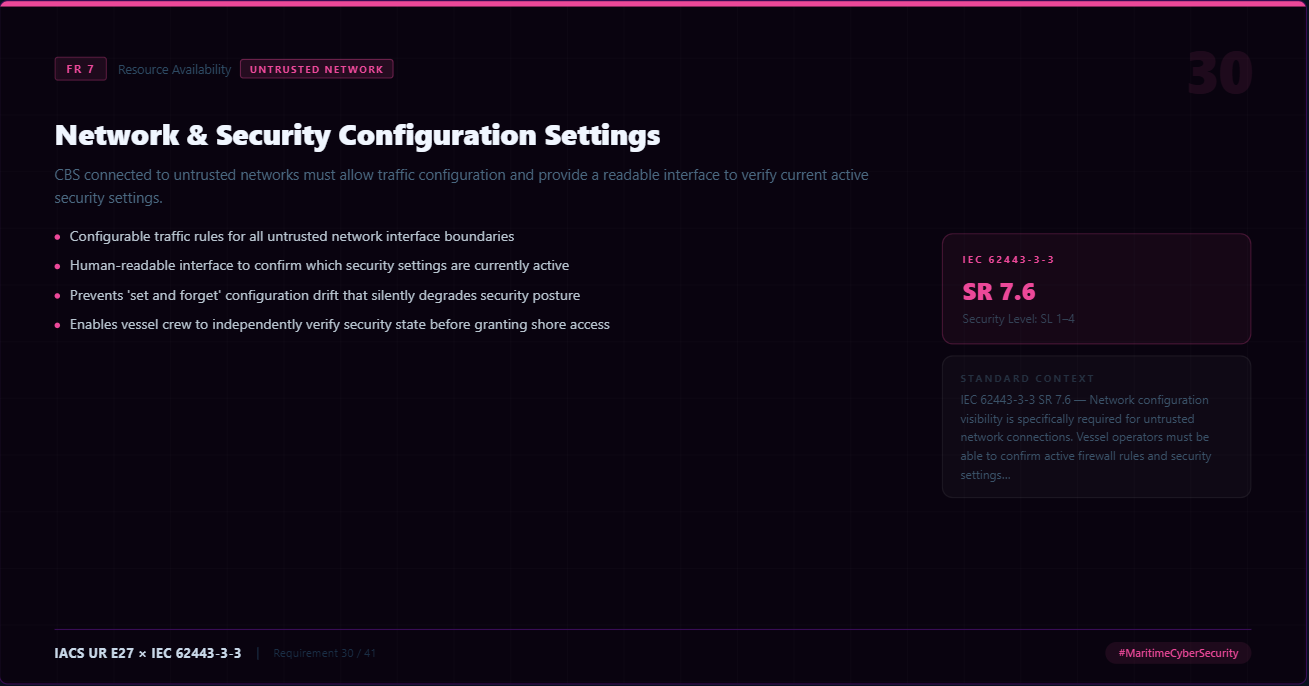
**Do you actually know what traffic your vessel's OT systems are allowing right now — or are you trusting a configuration that was set during commissioning and never verified since?**
That question sits at the heart of IACS UR E27's requirement on Network and Security Configuration Settings, and the answer on most vessels is uncomfortable.
**What UR E27 Demands**
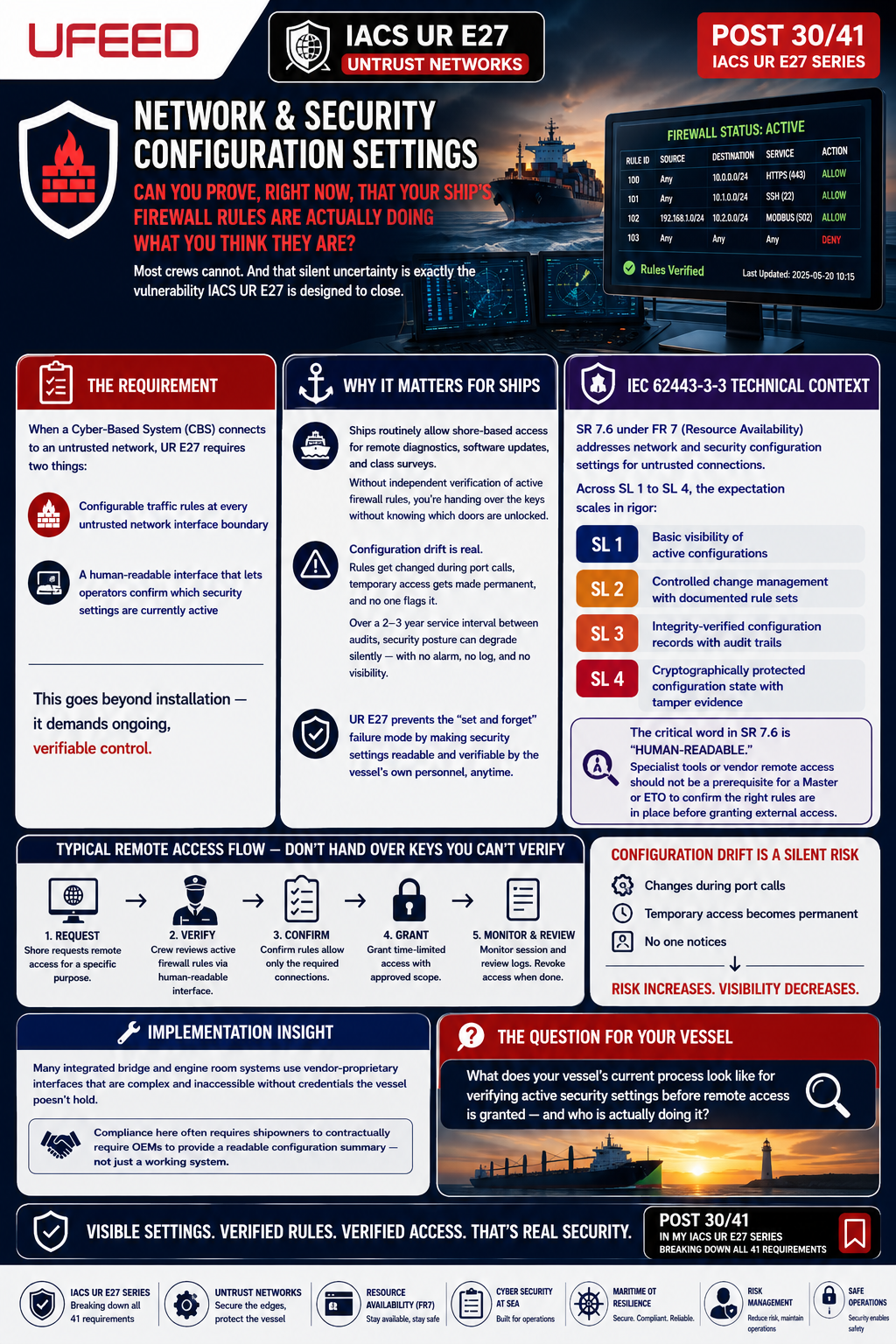
Any Computer-Based System connected to an untrusted network must provide two things: configurable rules governing traffic across that network boundary, and a human-readable interface that shows which security settings are currently active. Not what was configured at installation — what is active right now.
**Why This Matters at Sea**
Configuration drift is one of the most underappreciated threats in maritime OT environments. Firmware updates, network topology changes, or temporary rule exceptions granted during a port call can silently alter a vessel's security posture without anyone realising it. By the time a shore team requests remote access weeks later, the firewall rules in place may bear little resemblance to the approved baseline. Crew members need the ability to independently verify that security settings are correct before granting any external party access — without waiting for an OEM engineer or a shore-based specialist to confirm it for them.
**The IEC 62443-3-3 Technical Foundation**
SR 7.6 under Foundational Requirement 7 (Resource Availability) specifically addresses network and security configuration visibility. Across all four Security Levels — SL 1 through SL 4 — the standard requires that operators can confirm active firewall rules and boundary protection settings without relying on proprietary tools or vendor remote support. At higher security levels, the expectation extends to continuous monitoring of configuration integrity, ensuring that any deviation from the approved state is detected and flagged rather than discovered retrospectively during an incident investigation.
**The Implementation Challenge**
🔧 In practice, many integrated bridge and engine control systems present security settings through vendor-specific interfaces that are neither intuitive nor accessible to ship officers. A compliant implementation requires that the active configuration be presented in plain, unambiguous terms — ideally through a standardised dashboard that a competent officer can read and act on without specialist training. Designing that usability into systems built primarily for operational performance, not security transparency, is where most vendors still have significant work to do.
The vessels best positioned for UR E27 compliance are those where security state visibility is treated as an operational requirement, not an audit checkbox.
**What does your current OT security interface actually show your crew — and is it enough for them to make an informed access decision?**
📌 Post 30/41 in my IACS UR E27 series — breaking down all 41 requirements


