**If a cyber incident occurs on your vessel mid-ocean, can you actually prove what happened — and when?**
Without auditable events, the answer is almost certainly no.
---
**What UR E27 Requires**
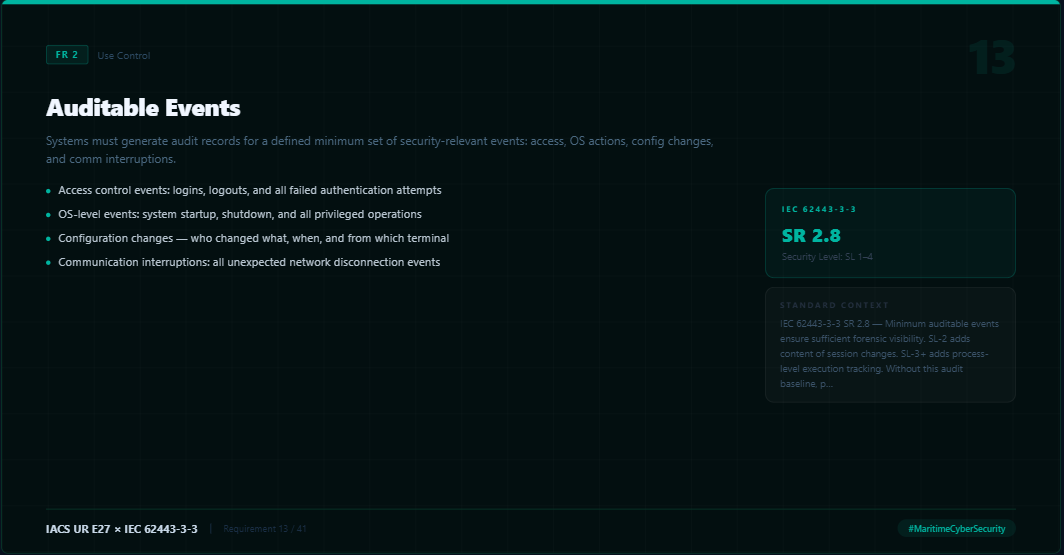
IACS UR E27 mandates that every Computer-Based System aboard a vessel must generate audit records for a defined minimum set of security-relevant events. This isn't optional logging — it's a baseline accountability function covering access control, operating system actions, configuration changes, and communication interruptions. Every CBS must produce this trail, consistently and automatically.
---
**Why This Matters at Sea**
A vessel operating in international waters is, by definition, an isolated environment. When something goes wrong with a navigation system, a propulsion controller, or an integrated bridge system, there is no on-call IT team and no enterprise SOC watching a dashboard ashore.
Audit logs are the forensic foundation that makes post-incident investigation possible. Without them, you cannot determine whether a crew member accidentally misconfigured a system, whether an unauthorized login occurred during a port call, or whether a network disruption was a hardware fault or deliberate interference.
The evidentiary gap doesn't just complicate investigations — it makes them impossible.
---
**The IEC 62443-3-3 Technical Layer 🔍**
SR 2.8 in IEC 62443-3-3 defines the minimum auditable events framework that underpins UR E27's requirement. The security level progression is meaningful here:
→ SL 1: Baseline logging of logins, logouts, failed authentication, OS startup/shutdown, privileged operations, configuration changes, and unexpected communication disconnections
→ SL 2: Adds session content changes, capturing not just that a session occurred, but what changed within it
→ SL 3 and above: Extends into process-level execution tracking, providing granular visibility into what software was running, when, and under what privileges
Each level builds forensic depth. For most shipboard OT environments, SL 2 should be the realistic target — and many are not yet meeting SL 1 consistently.
---
**The Implementation Reality**
The practical challenge in maritime OT is that many legacy CBS were never designed to generate structured audit logs at all. Retrofitting logging capability onto a propulsion management system or ballast water treatment controller often requires vendor involvement, middleware solutions, or careful use of network-layer monitoring to compensate for what the endpoint cannot natively produce. Plan for this complexity early.
---
**A question for practitioners:** When you audit a vessel's CBS estate, what percentage of systems can actually demonstrate a continuous, structured audit log from their last port call to today?
📌 Post 13/41 in my IACS UR E27 series — breaking down all 41 requirements

#AuditLogs #IACS #URE27 #IEC62443 #MaritimeCyberSecurity #SIEM #IncidentForensics
'Security > Maritime Cyber Security' 카테고리의 다른 글
| [IACS UR E27] FR2 Use Control - Response to Audit Processing Failures (0) | 2026.05.14 |
|---|---|
| [IACS UR E27] FR2 Use Control - Audit Storage Capacity (0) | 2026.05.14 |
| [IACS UR E27] FR2 Use Control - Session Lock (0) | 2026.05.13 |
| [IACS UR E27] FR2 Use Control - Mobile Code Control (0) | 2026.05.13 |
| [IACS UR E27] FR2 Use Control - Use Control for Portable & Mobile Devices (0) | 2026.05.13 |


