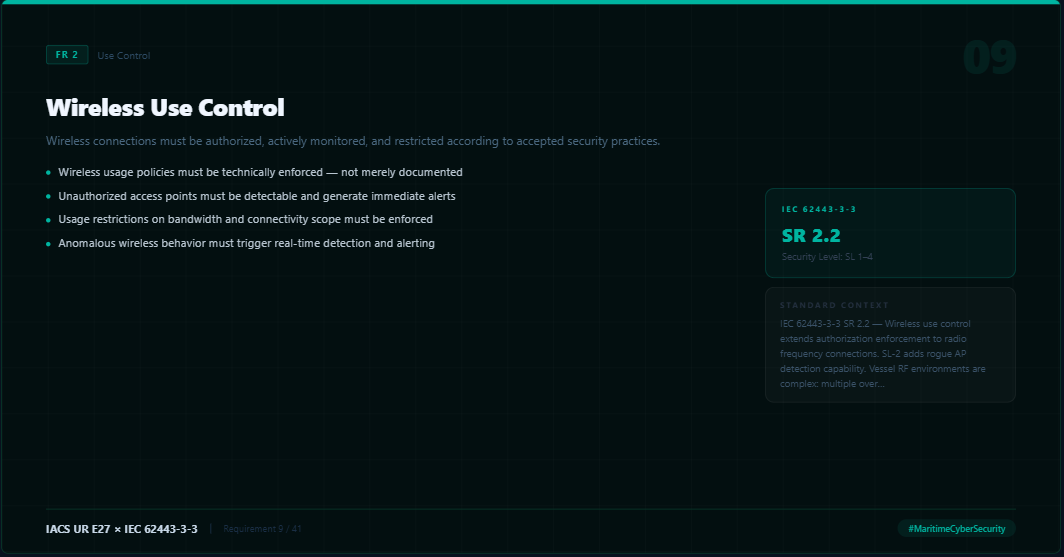
# Post 9/41 — Wireless Use Control
---
A crew member's personal hotspot just became your vessel's biggest cyber liability. And nobody on the bridge has any idea it's running.
---
**The Requirement**
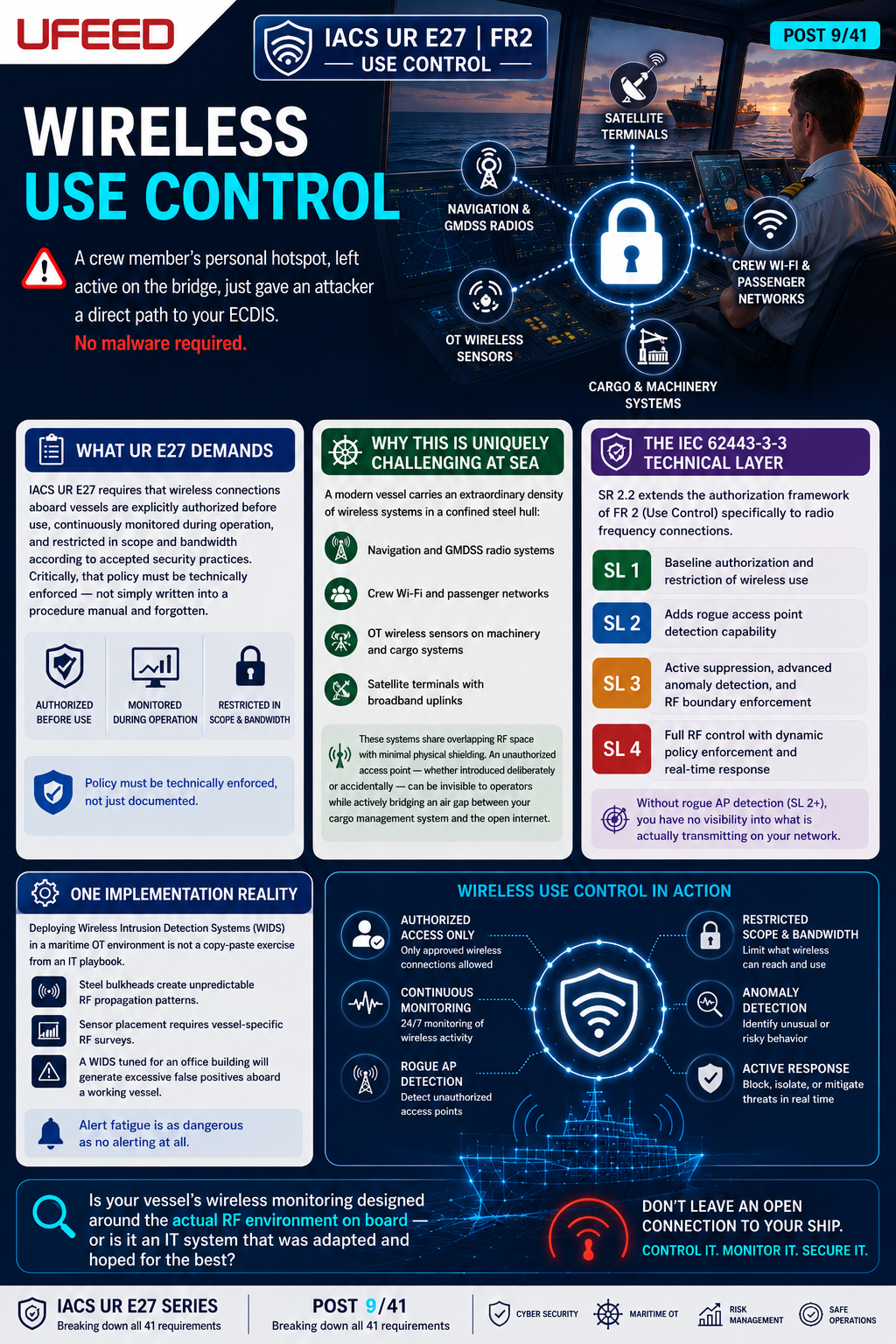
IACS UR E27 mandates that all wireless connections aboard Computer-Based Systems must be explicitly authorized, continuously monitored, and restricted in line with accepted security practices. Policy documents alone do not satisfy this — technical enforcement is required.
---
**Why It Matters for Ships**
Vessels are uniquely hostile environments for wireless governance. Steel hulls, confined spaces, and overlapping RF systems from navigation, GMDSS, crew welfare networks, and operational technology create a dense, largely unmanaged radio frequency landscape.
A rogue access point transmitting in the vicinity of an ECDIS workstation or engine control network is not a theoretical concern — it is a plausible daily scenario on any modern vessel. Unauthorized wireless access can bypass carefully constructed network segmentation, erasing layers of protection in seconds.
The consequences range from data exfiltration to direct interference with safety-critical OT systems.
---
**IEC 62443-3-3 Technical Context**
SR 2.2 under IEC 62443-3-3 extends the Use Control framework specifically to radio frequency connections — treating wireless access as a distinct and elevated risk surface.
At SL-1, the baseline requires authorized wireless use with documented restrictions. SL-2 introduces a technically significant step up: active rogue access point detection capability, meaning the system must be able to identify unauthorized wireless devices and generate immediate alerts — not simply log events passively.
SL-3 and SL-4 further tighten this through behavioral anomaly detection and continuous, real-time RF environment monitoring. For maritime OT environments handling safety-critical functions, SL-2 should be considered the realistic minimum.
---
**Implementation Insight 🔍**
One practical challenge unique to vessels: bandwidth and connectivity scope restrictions must be technically enforced at the network layer, not managed through crew awareness programs alone. Implementing wireless intrusion detection system (WIDS) capability integrated with the vessel's onboard security monitoring — and tuned to differentiate operational wireless traffic from anomalous signals — is a meaningful but achievable step that many current fleet installations have not yet taken.
---
What wireless systems aboard your vessels are currently outside your visibility window — and do you know how you would detect a rogue access point during an active voyage?
---
📌 Post 9/41 in my IACS UR E27 series — breaking down all 41 requirements
---
#WirelessControl #IACS #URE27 #IEC62443 #MaritimeCyberSecurity #NetworkSecurity #OTSecurity #ShipboardSystems


