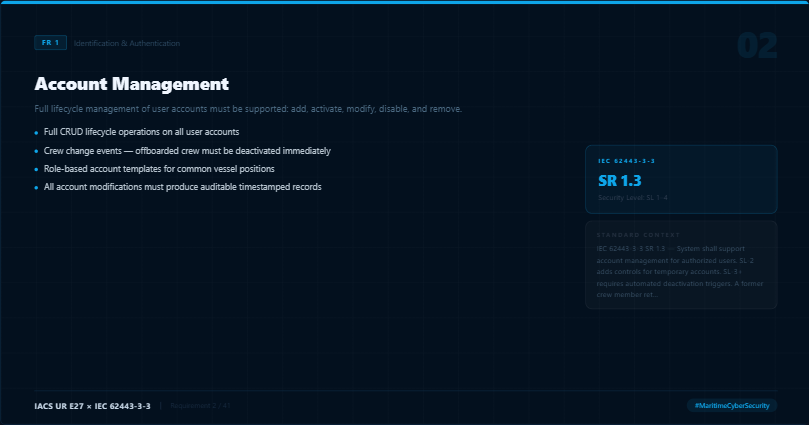
# Account Management: The Ghost Crew Problem
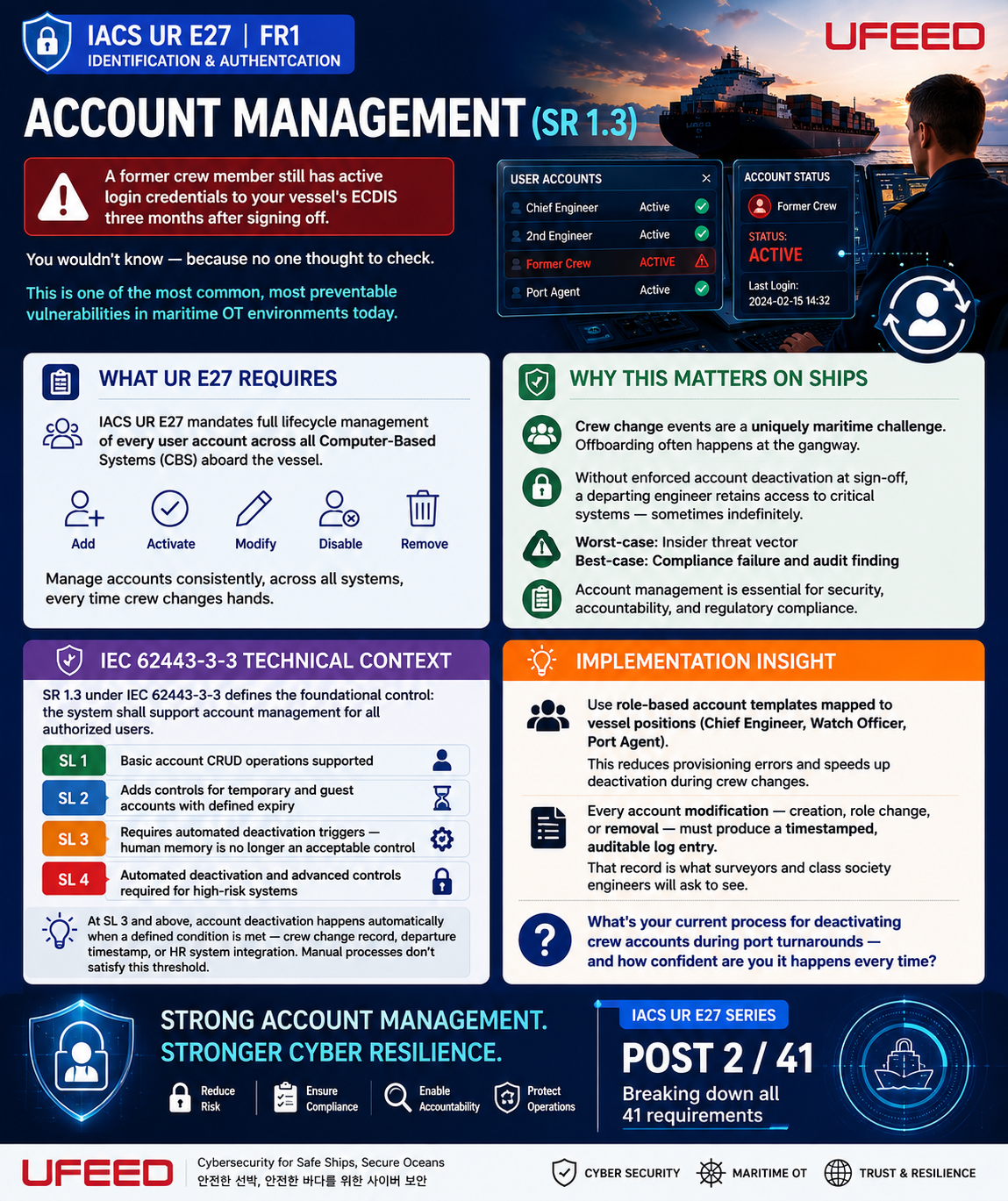
How many former crew members still have active accounts on your vessel's systems right now? If you don't know the answer, that's the vulnerability.
---
**What UR E27 Requires**
IACS UR E27 mandates full lifecycle management of every user account across all Computer-Based Systems aboard a vessel. That means the system must support the complete sequence: add, activate, modify, disable, and remove. No gaps, no exceptions, no accounts that simply get forgotten.
---
**Why This Matters on Ships**
Crew turnover on commercial vessels is relentless. A crew change in Rotterdam doesn't always trigger a systematic account audit across navigation, propulsion control, and cargo management systems. The result is a growing trail of dormant accounts belonging to engineers, officers, and technicians who no longer serve on that vessel — or that company.
A former crew member with retained credentials is not a theoretical risk. It is a documented attack surface. Whether through malice, credential theft, or simple negligence, those accounts represent unauthorized access waiting to happen.
---
**The IEC 62443-3-3 Technical Layer** 🔐
SR 1.3 of IEC 62443-3-3 defines the system-level requirement for account management, and the Security Level progression adds meaningful technical depth:
→ SL-1: Basic account management functions must exist
→ SL-2: Controls for temporary and contractor accounts are introduced
→ SL-3+: Automated deactivation triggers are required — the system must act, not rely on human memory
→ SL-4: Full integration with enterprise identity governance
For most vessels, SL-2 is the realistic baseline target. That means temporary accounts — used by port technicians, surveyors, and vendor engineers — must have defined expiry controls, not just manual deletion policies that depend on someone remembering.
---
**Implementation Reality**
The practical challenge in maritime OT is that many legacy control systems were never designed with centralized identity management in mind. Role-based account templates for common vessel positions (master, chief engineer, ETO) help standardize provisioning. But every modification — creation, privilege change, or deletion — must produce a timestamped, auditable record that survives the next system reboot.
Audit trails are not optional. They are how you prove the account was disabled before the incident, not after.
---
What processes does your organization currently use to ensure crew change events trigger immediate account deactivation across all onboard CBS?
📌 Post 2/41 in my IACS UR E27 series — breaking down all 41 requirements
#AccountManagement #IACS #URE27 #IEC62443 #MaritimeCyberSecurity #AccessControl
'Security > Maritime Cyber Security' 카테고리의 다른 글
| [IACS UR E27] FR1 Identification & Authentication - Authenticator Management (0) | 2026.05.11 |
|---|---|
| [IACS UR E27] FR1 Identification & Authentication - Identifier Management (0) | 2026.05.10 |
| IACS UR E27 - FR1 Human User Identification & Authentication (0) | 2026.05.08 |
| IACS UR E27 - Untrusted Networks (Items 30–41) (0) | 2026.05.08 |
| IACS UR E27 - FR6 + FR7: Event Response & Availability (0) | 2026.05.08 |


