What if someone silently modified your ship's navigation data mid-voyage?
You wouldn't know — unless your systems were built with UR E27 FR3 in mind.
System Integrity (FR3) and Data Confidentiality (FR4) cover 6 requirements
that protect the accuracy and secrecy of data critical to vessel operations.
⚙️ SYSTEM INTEGRITY (FR3 — Items 17–20)
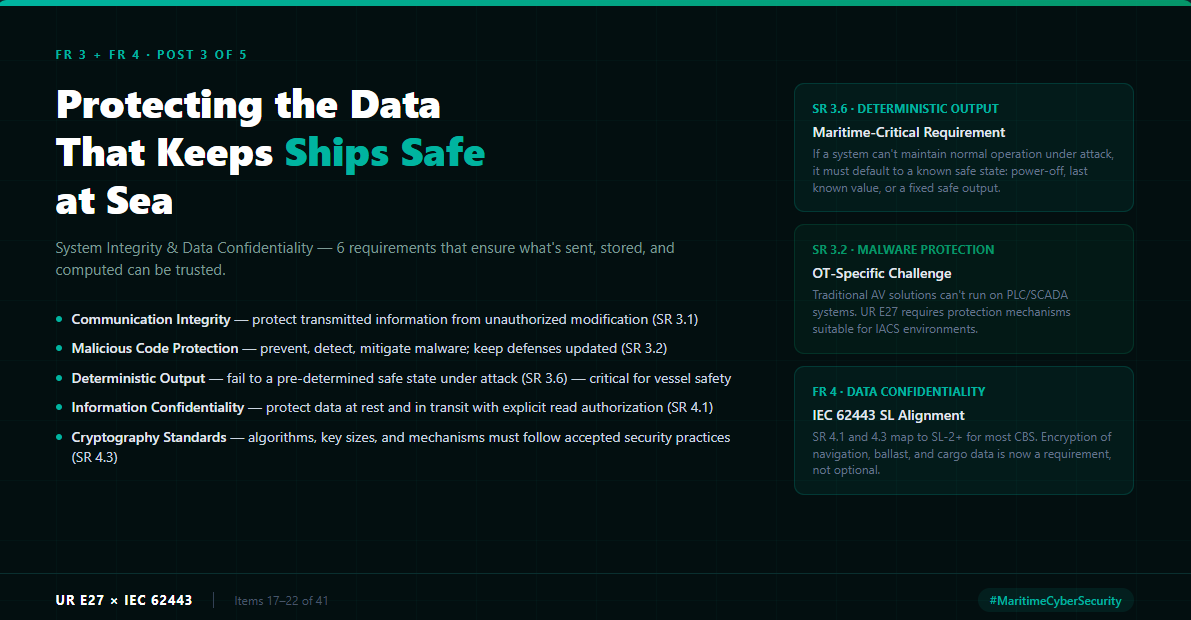
- Communication Integrity (SR 3.1): Protect transmitted information against unauthorized modification.
If data is altered in transit, the system must detect it.
- Malicious Code Protection (SR 3.2): Prevent, detect, and mitigate malware.
The challenge? Traditional AV won't run on a PLC.
E27 requires protection mechanisms appropriate for IACS environments.
- Security Functionality Verification (SR 3.3): Validate that security functions work as intended
during maintenance. Report anomalies.
- Deterministic Output (SR 3.6): The most safety-critical requirement.
If a CBS cannot maintain normal operation under attack, it MUST default to a
pre-determined safe state — power off, last known value, or a fixed safe output.
This bridges cyber security and functional safety (SOLAS relevance).
🔏 DATA CONFIDENTIALITY (FR4 — Items 21–22)
- Information Confidentiality (SR 4.1): Protect data whether at rest or in transit.
Navigation waypoints, cargo manifests, ballast configurations — all classified.
- Use of Cryptography (SR 4.3): Algorithms, key sizes, and mechanisms must follow
accepted industry practices. No weak ciphers. No default keys. No exceptions.
IEC 62443-3-3 context: SR 3.6 (Deterministic Output) has no equivalent in
traditional IT security standards — it exists precisely because IACS failures
have physical consequences. Ships. Cargo. Crews.
#MaritimeCyberSecurity #IACS #URE27 #IEC62443 #SystemIntegrity
#OTSecurity #DataProtection #MaritimeSafety
'Security > Maritime Cyber Security' 카테고리의 다른 글
| IACS UR E27 - FR1 Human User Identification & Authentication (0) | 2026.05.08 |
|---|---|
| IACS UR E27 - Untrusted Networks (Items 30–41) (0) | 2026.05.08 |
| IACS UR E27 - FR6 + FR7: Event Response & Availability (0) | 2026.05.08 |
| IACS UR E27 - FR1 + FR2: Identity & Use Control (0) | 2026.05.08 |
| IACS UR E27 - Series Introduction (0) | 2026.05.08 |